What is meant by on-demand transport?
Marco Schärli: With on-demand transport, a journey is made without a fixed timetable or route, but similar journeys are bundled together. A journey is only made on demand and different customers can be in the vehicle at the same time, so on-demand transport is somewhere between a taxi and public transport.
This leads to the next question: What role do traditional public transport companies play in this market?
M.S.: As a licensed transport company, ZVB is looking beyond its current core business. In the area of new mobility, we are looking closely at the topic of "on-demand transport". This is because we believe that public transport services for the so-called first and last mile should continue to be available to the population simply and easily in the future. The ZVB would like to gain experience, develop system expertise and position itself in the emerging competition.
Innovation, illusion or already introduced - what is the current status?
M.S.: According to the Alliance Swiss Pass trend radar, "on-demand" is still an innovation, but it is somewhere between "growth" and "introduction". Sustainable transport development doesn't just happen on its own. The development of services must be actively managed through the right measures. Projects in the area of on-demand transport require the use of capital, the establishment of partnerships and the willingness to learn in an agile manner. The ZVB is involved in a cross-company, national working group and is open to dialogue with the municipalities to develop service concepts.
What primary benefits do you hope to achieve?
M.S.: We hope that on-demand transport will increase the cost recovery ratio on neighbourhood lines, especially in the evening. And to provide access to less frequented locations away from the main roads or public transport lines (last mile). In other words, the classic public transport service should be usefully supplemented.
Are there any other advantages?
M.S.: Multimodal mobility is the keyword. We are thinking here of travel chains for which there is a seamless offer with different forms of mobility. On-demand transport is a link in this chain. It can open up the first and last mile. This leads to greater convenience for passengers in terms of comfort, accessibility, flexible routes and comprehensive services. Another advantage is a greater sense of security, especially during off-peak hours, as customers can use a service right up to the door. And last but not least, a higher occupancy rate or the substitution of private cars or taxis can increase transport efficiency and make better use of scarce space.
What challenges do you face?
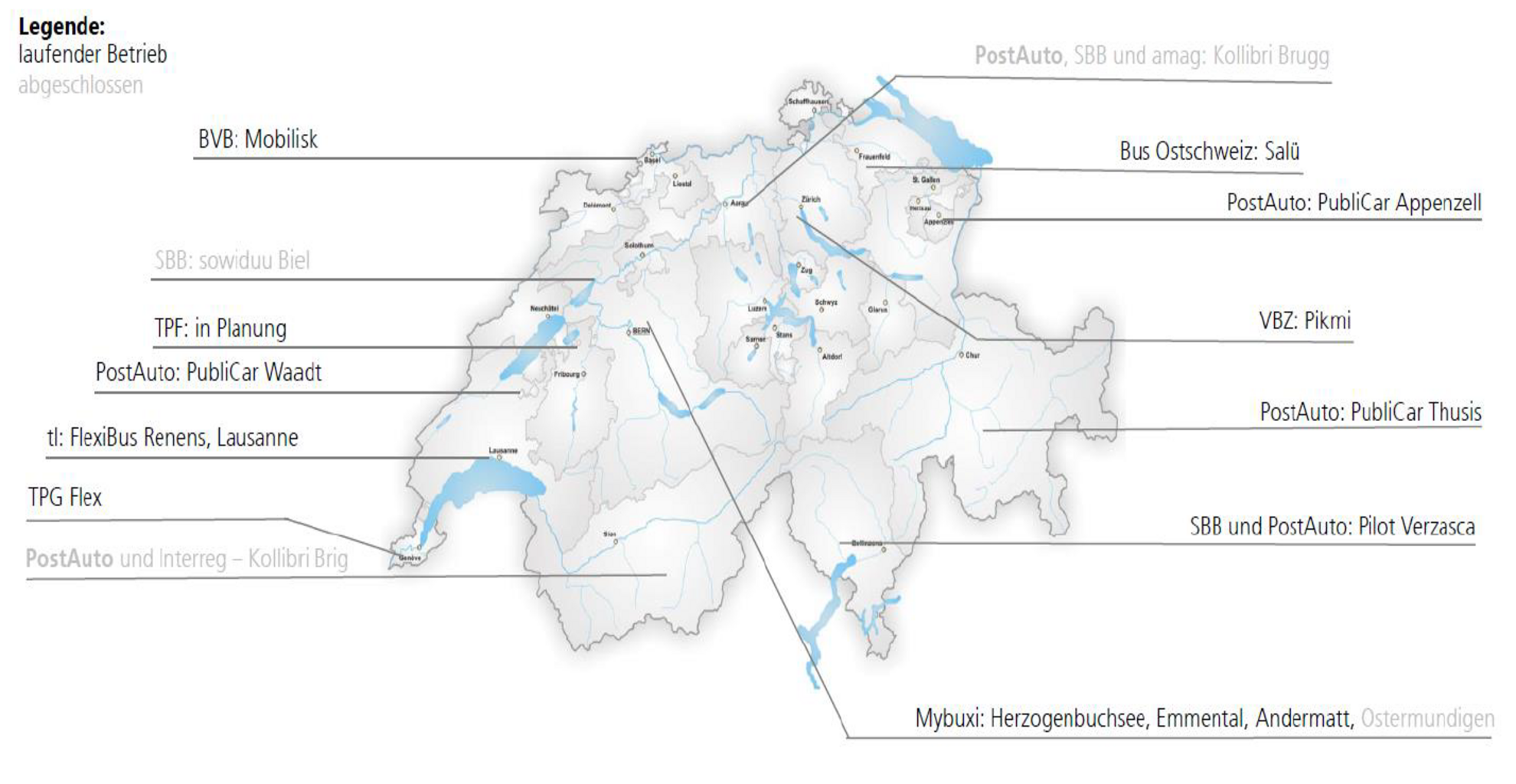
M.S.: Quite a few pilot trials are planned throughout Switzerland, are already being implemented or have even been completed. Funding has proved to be the biggest hurdle, with many projects failing. Another sticking point is easy access to the service. Customers do not want to have to install new apps; instead, the offering should be integrated into existing sales systems. As is often the case with innovations, regulation lags behind technical development and hinders the realisation of projects. There is also a need for support in terms of vehicle development, as private companies are focussing on small vehicles and less on shared vehicles. And finally, awareness is also a difficulty, as on-demand transport is much discussed in expert circles, but the general public is still not very sensitised to this topic.
Current pilot projects for on-demand transport
Source: PostBus (as of April 2022)